

Our contribution to
sustainable development goals
The UN has defined and adopted 17 Sustainable Development Goals (SDGs) to be achieved by 2030, in favour of economic and social development that is more respectful of people and the planet.
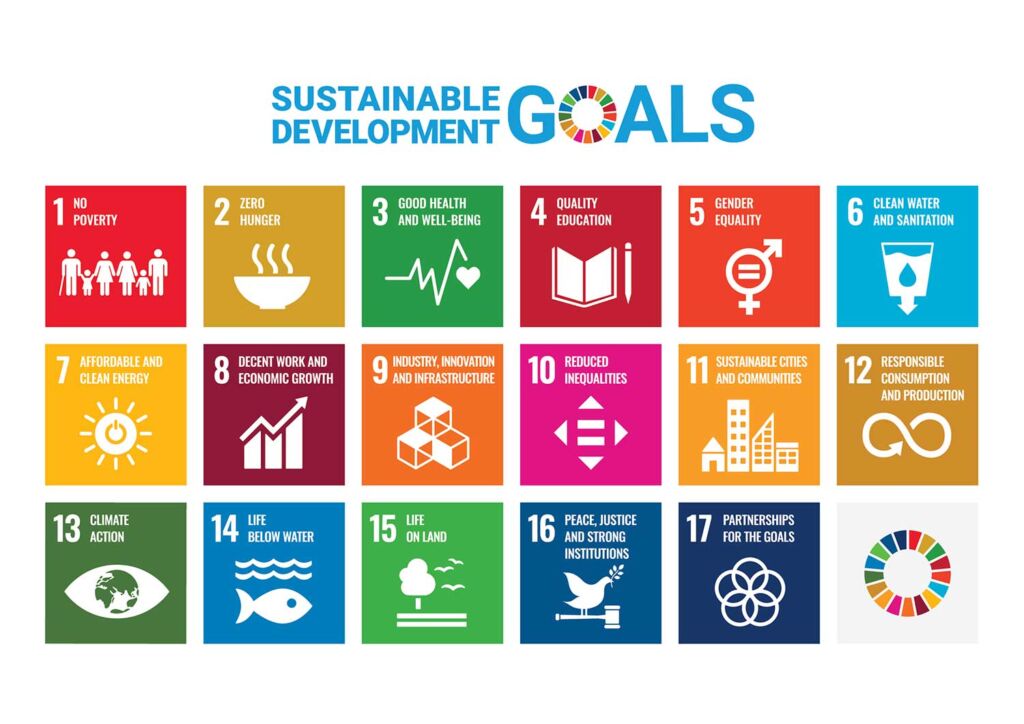
Through its commitments, BAT’IPAC contributes to 12 of these goals:
Through our collaborative business model based on inclusive growth, we contribute to poverty reduction by supporting local economic development and employment, thanks to the relocation of production to local areas.
We design materials from recycled and recyclable cardboard, for which there are no known allergies or harmful dust emissions, making them healthy for all users, throughout all stages of their life cycle: design, implementation, acceptance, operation, renovation or deconstruction, reuse or recycling.
In this way, we help to maintain air quality in user buildings and preserve the health of users.
Thanks to the thermal, phonic and acoustic performance of our materials, we contribute to improving summer comfort and the well-being of building users.
Through our collaborative business model, based on a reasoned industry with the global DS Smith packaging Group, we pay particular attention to the quality of our supplies and the performance of our suppliers in terms of sustainable resource management. The production sites for the recycled cardboard we use to manufacture our materials are equipped with wastewater treatment systems that enable water to be reused and recycled in a closed circuit without drawing water from the local network.
We considerably limit our impact on water resources, because we design materials that require no water consumption either during manufacture or during use, processing, dismantling or reuse.
Our materials are also designed to be integrated into “zero concrete” construction systems that enable to fight against soil sealing, facilitate natural penetration of rainwater and irrigation, and thus contribute to improved management of water resources.
Through our collaborative business model, based on reasoned industry with the global DS Smith packaging group, deeply committed to the decarbonisation of its activities with a goal of zero net emissions by 2050 worldwide, by investing in both new technologies to optimise energy in real time, and by transitioning to renewable energy solutions (methanization, biomass, biofuels) for each of our production sites, we pay particular attention to the carbon footprint performance of our suppliers. The recycled cardboard we use to manufacture our products comes from factories that recycle 100% of their waste into energy.
We design products which thermal performance helps to reduce energy consumption in end-user buildings (air conditioning in summer, heating in winter), thereby significantly lowering energy bills for occupants. In this way, we are helping to reduce fuel poverty in households by offering sustainable solutions for home renovation.
Through our collaborative business model, based on inclusive growth, we contribute to the development of labour-intensive productive activities, and training opportunities for “sustainable” jobs in the construction sector, a sector with high added value.
Through our innovative, disruptive business model, we are demonstrating that it is possible to combine industry, sustainable and social development, respect for the environment and inclusion through employment, and in so doing are helping to move society towards a more sustainable world.
Thanks to our low-tech production infrastructure, which is quick to set up and inexpensive and therefore easily reproducible, we are helping to create job opportunities and skills in areas hit by social inequalities or job vacancies.
Thanks to the low-carbon solutions we are developing, we are helping to increase the share of eco-construction and are taking action for sustainable buildings.
Through our inclusive business model, we place people at the heart of our concerns by entrusting 100% of the manufacture of our products to people with disabilities and/or in need of social integration, and thus contribute to reducing inequalities and facilitating the inclusion of vulnerable people through access to training and rewarding employment.
Thanks to the solutions we develop for sustainable construction, we contribute to the challenges faced by cities and communities to limit the artificialization of land, the consumption of resources, and the deterioration of air quality and the environment, while supporting local dynamism through a territorial network of production.
Our production lines are set up in existing social integration structures (ESATs, social integration organizations, adapted organizations, prisons, etc.), positioned as close as possible to the end market, thus favouring short circuits.
We have integrated the circular economy into our value chain and into the design of our products, , thereby helping to reduce the amount of paper and cardboard waste on the planet by recovering it through existing recycling channels to produce bio-based building materials without drawing on the primary resource.
In fact, this virtuous cycle can be renewed 9 times without the need to add new material, since our products, which themselves come from paper and cardboard recycling, are entirely recyclable.
Through our “cradle to cradle” model and the sustainability and reusability of our products, we contribute to responsible production in the building sector and to the reuse of materials at the end of their life cycle..
We design products made from recycled corrugated cardboard, which, thanks to its natural cellulose fibres, is similar to a bio-sourced material that stores carbon. In this way, we are helping to reduce carbon dioxide emissions in a sector responsible for almost a third of greenhouse gas.
Through our products requiring low water consumption, no consumption of sand, low energy consumption, throughout their life cycle, and their thermal performance in their use, we are contributing to the transition to a low-carbon, sustainable economy to limit the effects of climate change.
The intrinsic characteristics and qualities of our products make them materials that fit perfectly into construction, renovation or deconstruction projects that take environmental impact into consideration by reducing:
- The overexploitation of resources (no sand, no deforestation, little water)
- The artificialization and waterproofing of soils (“0 concrete”)
- The energy consumption (low carbon footprint throughout the life cycle)
- Waste (renewable and recyclable material in the circular economy)
In this way, we are contributing to the building sector’s major challenge in preserving biodiversity, particularly in urban environments.
We have forged strong partnerships with organizations that share common principles and values: Ds Smith Packaging, Groupe Estille, BeeHive For The Environment, and place people and the planet at the heart of their concerns, to create a collaborative economic model through which we contribute together to sustainable development.
We are also members of the RUPTUR association, committed to contributing to a more responsible and sustainable economy.
Alongside the Solar Impulse Foundation, which certified our solution for sustainable construction at the end of 2022, and the 1000+ other planet-efficient solutions identified around the world, we are helping to promote clean, cost-effective technological solutions to fight against climate change and secure the future of our societies..
We are also supported in our commitment by the associations and foundations to which we belong and whichwork for sustainable construction through the bio-sourced sector: FIBOIS, NOYABUILD, AICB..